

 中文简体
中文简体 Español
Content
- 1 What Jacquard Fabric Is and How It Is Made
- 2 Common Types of Jacquard Fabric and Their Applications
- 3 Types of Fabric Printers and How They Work
- 4 Comparing Fabric Printer Types for Jacquard Applications
- 5 Challenges of Printing on Jacquard Fabric
- 6 Design Considerations When Combining Jacquard Weave and Print
Jacquard fabric occupies a unique position in the textile world — it is one of the few fabric categories where the pattern is built structurally into the weave itself rather than applied to the surface through printing or dyeing. Yet today, jacquard fabric is also increasingly used as a premium printing substrate, with digital and specialized fabric printers unlocking design possibilities on woven textiles that were simply not achievable a decade ago. Whether you are a textile designer, a fabric buyer, a print shop operator, or a product developer working with woven fabrics, understanding what jacquard fabric actually is, how it behaves compared to other substrates, and which fabric printer types are best suited to working with it will give you a significant practical advantage over those who treat all fabric printing as interchangeable.
What Jacquard Fabric Is and How It Is Made
Jacquard fabric is produced on a Jacquard loom — a weaving machine equipped with a mechanism that allows individual warp yarns to be controlled independently of one another during the weaving process. This individual yarn control, originally achieved through a system of punched cards invented by Joseph Marie Jacquard in 1804 and now managed by computerized electronic heads, enables the loom to produce complex, multi-colored patterns with extraordinary detail directly in the woven structure of the fabric. Because the pattern is formed by the interlacing of different colored warp and weft threads — rather than by printing or dyeing after weaving — the resulting design is present throughout the fabric's thickness and appears on both sides of the cloth, with the reverse typically showing a complementary or mirror version of the face pattern.
Modern Jacquard looms are fully digitally controlled, allowing designers to create patterns using CAD software and transfer them directly to the loom's control system with no manual card-punching or physical programming required. This digital workflow has made complex jacquard patterns economically viable for much shorter production runs than was historically possible, and has expanded the design vocabulary available to jacquard weavers to essentially unlimited geometric, figurative, and photographic complexity. The practical limits on jacquard pattern resolution are determined by the number of independently controlled warp ends per centimeter — finer yarns at higher densities allow more intricate designs — and the number of weft colors or weave structures the pattern incorporates.
Common Types of Jacquard Fabric and Their Applications
The term "jacquard" describes a weaving method rather than a specific fiber, construction weight, or end use — which means jacquard fabric encompasses an enormous range of products made from different fibers, at different weights, and for very different applications. Understanding the main categories helps clarify which types are also printable substrates and which are purely structural pattern fabrics.
Silk Jacquard
Silk jacquard is the most historically prestigious form, traditionally associated with high fashion, interior design, and ceremonial textiles. The natural luster of silk filament amplifies the visual contrast between woven pattern areas with different weave structures — typically combining satin-weave face floats with twill or plain-weave ground — producing the characteristic shimmer and depth that flat-woven or printed fabrics cannot replicate. Silk jacquard is used for evening wear, couture garments, luxury neckties, and premium home furnishings including drapery and cushion covers. Its smooth, tight woven surface also makes it a viable substrate for digital fabric printing when additional surface decoration beyond the woven pattern is required.
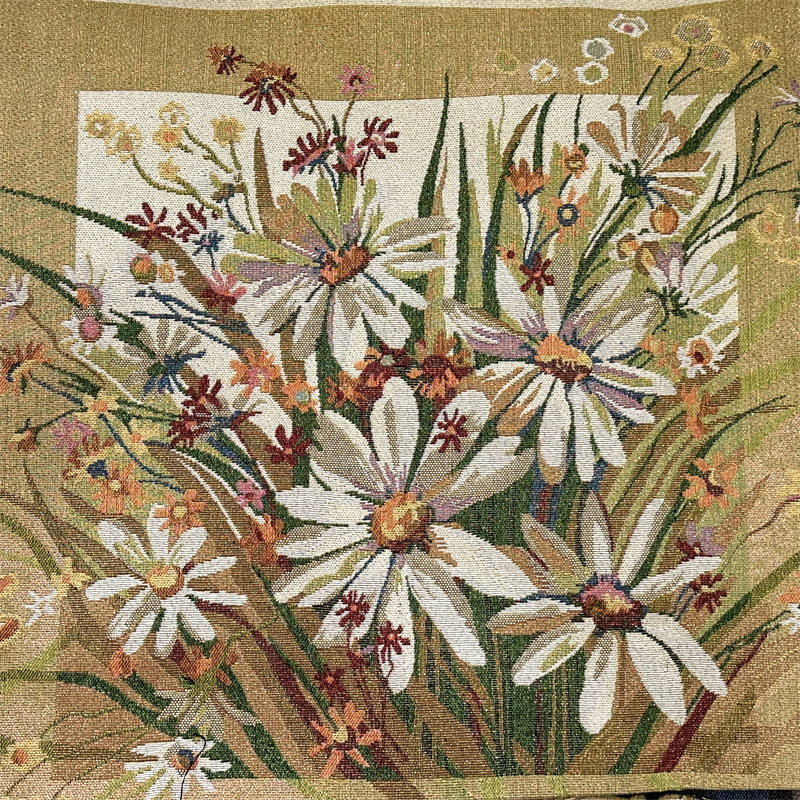
Polyester Jacquard
Polyester jacquard is the dominant volume category in modern jacquard fabric production, driven by the fiber's low cost, color vibrancy, dimensional stability, and compatibility with disperse dye and sublimation printing processes. Polyester jacquard is used extensively in sportswear, activewear, bags, upholstery, and promotional products. Its woven structure provides weight and durability superior to single-layer polyester wovens or knits, while the Jacquard pattern adds visual and tactile complexity that distinguishes it from plain woven alternatives. Crucially, polyester jacquard's composition makes it highly compatible with sublimation printing — one of the most important fabric printing technologies for adding photographic full-color graphics to woven polyester textiles.
Cotton and Cotton-Blend Jacquard
Cotton jacquard is widely used in home textiles — particularly bed linen, toweling, tablecloths, and upholstery — where its breathability, absorbency, and washability align with the end-use requirements. Cotton jacquard damask, with its traditional floral or geometric patterns in contrasting satin and matte weave areas, remains a staple of premium table linen and institutional hospitality textile supply. Cotton-blend jacquards incorporating viscose, linen, or silk with cotton combine the structural properties of the base fiber with the luster or drape contributions of the secondary fiber. These blended constructions are increasingly specified for fashion and interior applications where pure cotton's visual flatness is considered insufficient for premium positioning.
Types of Fabric Printers and How They Work
When printing is applied to jacquard fabric — either to add color where the woven structure provides texture, or to print photographic or complex graphic content across the woven surface — the choice of printer type determines print quality, color gamut, production speed, substrate compatibility, and total cost per meter. There are four principal fabric printer types used in commercial textile production, each based on a different ink and imaging technology.
Direct-to-Fabric Inkjet Printers (Digital Textile Printers)
Direct-to-fabric inkjet printers are the dominant technology in modern digital textile printing. They use piezoelectric print heads to jet microscopic droplets of ink directly onto the fabric surface as it moves through the printer, building up the image one pass at a time. The specific ink chemistry used depends on the fiber composition of the fabric being printed. Reactive inks are used for cotton, linen, viscose, and other cellulosic fibers — they chemically bond with the fiber during a post-print steaming and washing process to produce washfast, vibrant colors with excellent penetration into the fabric structure. Acid inks are used for silk, wool, nylon, and other protein or polyamide fibers, producing similarly penetrating, washfast prints through a fixation process. Disperse inks are used for polyester, including polyester jacquard, and require a heat fixation stage — either direct fixation on the printer or a subsequent heat press or steamer process — to drive the dye into the polyester fiber and achieve full color development and washfastness.
Dye Sublimation Printers
Dye sublimation is technically a two-step process rather than direct fabric printing — the design is first printed onto a release paper using sublimation inks, then the paper is pressed against the fabric under heat (typically 190 to 210°C for 30 to 60 seconds), causing the sublimation inks to convert from solid to gas and penetrate the polyester fiber structure, where they bond permanently upon cooling. The result is a print that is embedded within the fiber rather than sitting on its surface, producing exceptional washfastness, color vibrancy, and resistance to cracking or peeling. Dye sublimation is exclusively compatible with polyester or high-polyester-blend fabrics because the dye's chemical bonding mechanism only works with the polyester polymer chain. For polyester jacquard fabric, sublimation printing delivers photographic-quality full-color graphics over the textured woven surface — a combination that creates distinctive premium aesthetic products for sportswear, fashion, and interior design applications.
Screen Printing Systems
Rotary and flat-bed screen printing systems remain the dominant technology for high-volume, repeat-pattern fabric printing in industrial textile production. Each color in the design requires a separate screen, and ink is pushed through the screen's open mesh areas onto the fabric surface in sequence. Screen printing offers very high production throughput — rotary screen printing machines operate at speeds of 30 to 100 meters per minute — and delivers consistent, repeatable color across long production runs at lower ink cost per meter than digital inkjet printing. However, screen printing is economically justified only at production volumes where the substantial setup cost (screen making, ink mixing, machine preparation) is amortized across sufficient fabric length. For jacquard fabrics, screen printing adds surface color to the woven structural pattern but cannot economically produce the photographic resolution, color gradients, or short-run flexibility that digital printing offers.
Pigment Inkjet Printers
Pigment-based digital textile printers apply pigment inks — colorants suspended in a binder system rather than chemically bonding with fiber — to fabric surfaces. Because pigment inks sit on the fabric surface rather than penetrating the fiber, they are compatible with virtually any fiber type without requiring fiber-specific ink chemistry changes, making them uniquely versatile for printing on blended or multi-fiber fabrics including jacquard constructions that may incorporate several different fiber types in their warp and weft. Modern pigment digital printers have significantly improved washfastness and color range compared to earlier generations, and they eliminate the wet processing (steaming, washing) required by reactive and acid inks, reducing water consumption, wastewater handling requirements, and processing infrastructure. For printing on cotton jacquard, linen jacquard, and natural fiber blended jacquards where reactive ink direct printing would require wet processing investment, pigment inkjet printing offers a compelling alternative with lower total system cost.
Comparing Fabric Printer Types for Jacquard Applications
No single printer type is optimal for all jacquard printing applications. The following comparison summarizes the key trade-offs across the dimensions most relevant to jacquard fabric printing decisions.
| Printer Type | Compatible Jacquard Fibers | Print Resolution | Min. Run Length | Post-Processing Required |
| Direct inkjet (reactive) | Cotton, silk, viscose jacquard | Very high | 1 meter | Steam + wash |
| Direct inkjet (disperse) | Polyester jacquard | Very high | 1 meter | Heat fixation |
| Dye sublimation | Polyester jacquard only | Very high | 1 meter | Heat press transfer |
| Pigment inkjet | All fiber types | High | 1 meter | Curing only (no wet process) |
| Rotary screen | Most fiber types | Moderate | 500–1,000+ meters | Steam + wash |
Challenges of Printing on Jacquard Fabric
Printing onto jacquard fabric presents specific technical challenges that do not arise when printing on smooth, flat wovens or knits, and these challenges must be addressed in both the printer setup and the design stage to achieve acceptable print quality.
- Surface texture affects ink drop placement: The raised and recessed areas of a jacquard weave pattern create a micro-topography on the fabric surface. Inkjet droplets landing on raised warp float areas behave differently from those landing in recessed ground weave areas — absorption rates, spreading behavior, and dot placement accuracy all vary across the textured surface. This can produce visible print density variation that follows the woven pattern structure, particularly in large flat-color print areas. Designing prints with this texture interaction in mind — using tonal variation or intentional pattern overlap with the weave structure — reduces the visibility of this artifact in the finished product.
- Fabric stability during printing: Woven jacquard fabrics, particularly those incorporating loose float yarns or high thread counts, can be dimensionally less stable than tight plain-weave fabrics during the printing process. Fabric distortion or elongation in the print zone causes pattern registration errors and color mis-alignment in multi-pass digital printing. Sticky-belt transport systems on modern digital textile printers, which hold the fabric flat and dimensionally stable against a belt during printing, significantly mitigate this problem compared to older roll-to-roll transport designs.
- Ink penetration depth and coverage: Jacquard fabrics are typically heavier and denser than plain-weave fabrics of equivalent yarn count, which can limit ink penetration to the surface layers of the fabric. Insufficient ink penetration produces prints that appear adequately colored from the front but show significant color loss or "ghosting" on the fabric reverse — acceptable for some applications but problematic for fashion and home textile products where the reverse is visible. Increasing ink volume per pass and optimizing fixation parameters (steaming time and temperature for reactive inks; heat press time and temperature for sublimation) improves penetration into dense jacquard structures.
Design Considerations When Combining Jacquard Weave and Print
The most successful printed jacquard products use the relationship between the woven structure and the print design as an intentional design element rather than treating them as independent layers that happen to coexist on the same substrate. Several design approaches consistently produce strong results when combining jacquard texture with printed graphics.
- Tonal print over woven pattern: Printing a semi-transparent or tonal color wash over a woven jacquard pattern allows the structural texture to remain visible through the print, creating a layered visual depth that is impossible to achieve with either the print or the weave alone. This approach is widely used in fashion fabric development to add seasonal color to base jacquard constructions without obscuring the tactile value of the weave.
- Complementary scale relationship: Designs where the printed motif scale complements rather than conflicts with the scale of the woven jacquard pattern produce the most harmonious results. Large-scale printed graphics work well over small-repeat jacquard textures; small printed details are best applied to smooth or very fine jacquard constructions where the weave texture does not visually compete with the fine print detail.
- Registration-independent abstract prints: In high-volume production where exact print registration to the weave pattern repeat cannot be guaranteed, designing print patterns that do not require precise alignment with the woven repeat — abstract watercolor washes, all-over floral patterns, or deliberately free-placement motifs — eliminates registration as a production constraint while maintaining visual interest across the full woven and printed surface.
Jacquard fabric and digital fabric printing are individually powerful textile technologies; together, they open a design space that neither can access alone. Understanding the structural character of jacquard fabric — its fiber composition, weave architecture, surface texture, and behavior as a printing substrate — and matching that understanding to the capabilities and limitations of the available fabric printer types is the foundation of making informed decisions at every stage of jacquard product development, from initial design concept through production specification and quality validation.