

 中文简体
中文简体 Español
Content
- 1 What Is Jacquard Fabric and Why Does It Stand Out?
- 2 The Origins of Jacquard Weaving
- 3 How Jacquard Fabric Is Made
- 4 Common Types of Jacquard Fabric
- 5 Jacquard Fabric in Fashion and Interior Design
- 6 How to Identify Genuine Jacquard Fabric
- 7 Caring for Jacquard Fabric
- 8 Jacquard Fabric in the Era of Digital Textile Production
What Is Jacquard Fabric and Why Does It Stand Out?
Jacquard fabric is one of the most technically sophisticated textiles in the world, yet it remains widely misunderstood. Many people encounter it in upholstery, evening wear, or decorative pillows without knowing what makes it fundamentally different from printed or embroidered fabric. The answer lies entirely in how the pattern is created — not on the surface, but within the weave itself. Understanding jacquard fabric means understanding a revolution in textile manufacturing that began in the early 19th century and continues to influence both fashion and technology today.
The Origins of Jacquard Weaving
Jacquard fabric takes its name from Joseph Marie Jacquard, a French weaver and inventor who in 1804 introduced an attachment to the loom that automated complex pattern weaving. Before his invention, producing intricate woven designs required multiple skilled workers manually controlling individual warp threads — a slow, expensive, and error-prone process. Jacquard's loom attachment used a series of punched cards to control which threads were raised during each pass of the shuttle, enabling a single weaver to produce highly detailed patterns with remarkable consistency.
The historical significance of the Jacquard loom extends beyond textiles. The punched card system it used became an early model for programmable machines and directly influenced Charles Babbage's concept of a computing engine. In this sense, jacquard fabric carries within its threads a lineage that connects handcraft tradition to the origins of modern computing — a genuinely remarkable legacy for a piece of cloth.
How Jacquard Fabric Is Made
What distinguishes jacquard from other patterned textiles is that its design is woven directly into the structure of the fabric. On a jacquard loom — now controlled by digital software rather than punched cards — each individual warp thread can be raised or lowered independently, regardless of what neighboring threads are doing. This level of control allows the weaver to create patterns with complex color transitions, intricate motifs, and fine detail that simply cannot be achieved through standard weaving techniques.
The process begins with a digital design file, which is translated into instructions for the loom. As the fabric is woven, different combinations of warp and weft threads are interlaced to produce the pattern. Because the design exists within the weave structure, it is permanent — it will not fade, crack, or peel the way printed patterns can. This structural integrity is one of the primary reasons jacquard fabric is associated with quality and durability.
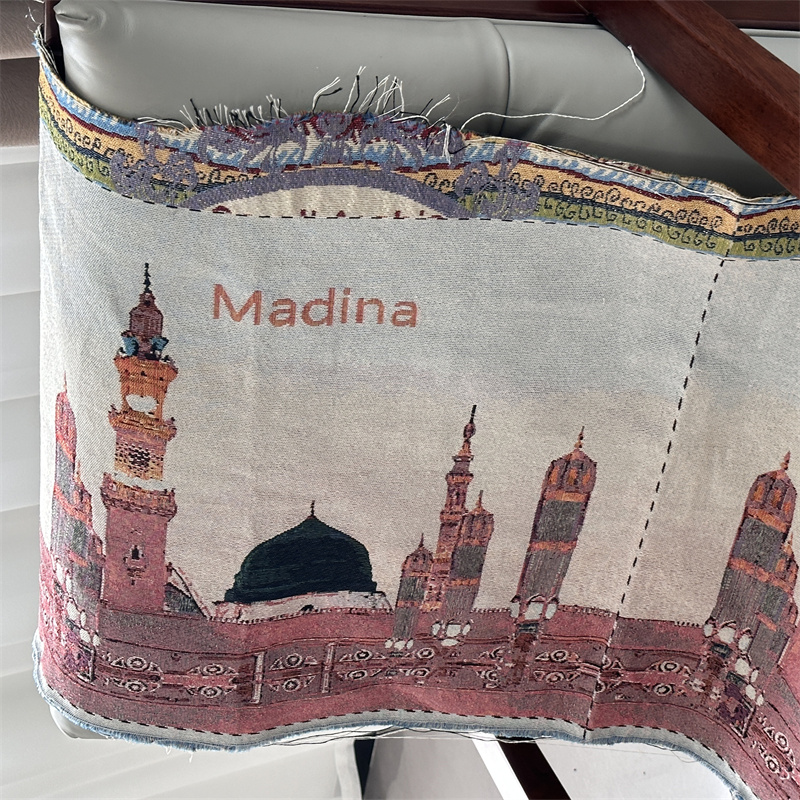
Key Weaving Characteristics
- Each warp thread is controlled independently, allowing for unlimited pattern complexity.
- Patterns are structural, not applied — making the fabric reversible in many cases.
- Multiple yarns and fiber types can be incorporated in a single piece.
- Modern jacquard looms are computer-controlled, enabling rapid design changes and precise reproduction.
Common Types of Jacquard Fabric
Jacquard is not a single fabric but a category of woven textiles produced using the jacquard technique. The fiber content, yarn type, and weave structure can vary widely, resulting in fabrics with very different textures, weights, and end uses. The following table outlines the most common jacquard fabric types and their typical applications:
| Fabric Type | Fiber Content | Characteristics | Common Uses |
| Brocade | Silk, polyester, or blends | Raised, embossed-looking patterns; heavy and stiff | Eveningwear, upholstery, curtains |
| Damask | Silk, cotton, linen, or polyester | Reversible; subtle sheen contrast between pattern and background | Tablecloths, bedding, drapery |
| Tapestry | Wool, cotton, synthetic | Dense, pictorial designs; very heavy | Wall hangings, bags, heavy upholstery |
| Matelassé | Cotton, silk, or blends | Quilted or padded appearance; double-cloth construction | Bedcovers, jackets, bridal wear |
| Jacquard Knit | Cotton, wool, acrylic | Stretch; patterned through knit structure rather than weave | Sweaters, sportswear, socks |
Jacquard Fabric in Fashion and Interior Design
In fashion, jacquard fabric has long been associated with luxury and formal occasions. Brocade blazers, damask evening gowns, and matelassé bridal dresses are all examples of how the fabric brings structural elegance to garments without requiring embellishment. The woven pattern adds visual richness and texture while remaining integral to the cloth, so the garment holds its appearance even after years of wear.
Contemporary fashion designers have broadened jacquard's role considerably. Streetwear brands use jacquard knits for logo-forward hoodies and caps, while sportswear manufacturers incorporate jacquard weaving into performance fabrics that require precise surface textures for aerodynamic or moisture-management purposes. This range — from haute couture to athletic gear — reflects how versatile the technique has become in modern manufacturing.
In interior design, jacquard fabric is a staple for upholstery, drapery, and decorative cushions. Its durability makes it well suited for high-use furniture, and its visual depth adds a level of sophistication that flat-printed fabrics struggle to match. Damask curtains in a dining room, brocade chair fabric in a study, or tapestry cushions on a sofa all draw on the same weaving tradition to deliver layered, textured aesthetics that hold up both physically and visually over time.
How to Identify Genuine Jacquard Fabric
Because jacquard is sometimes confused with printed fabric or embroidery, it helps to know how to identify it. The most reliable test is to look at the reverse side of the fabric. Jacquard fabric typically shows a recognizable mirror or negative version of the pattern on the back, formed by the floating threads that are not part of the visible surface design. Printed fabric, by contrast, will show a faded or blank reverse. Embroidered fabric will show the back of stitching rather than a woven structure.
Another indicator is the texture. Run your fingers across the fabric — genuine jacquard will have a tactile quality where the pattern is raised or recessed relative to the background, because the interlacing of threads creates physical dimension. This dimensional quality is particularly pronounced in brocade and matelassé. If the pattern feels completely flat and uniform under your fingertips, it is more likely printed than woven.
Caring for Jacquard Fabric
Proper care depends heavily on the fiber content of the specific jacquard fabric, but there are general principles that apply across most types. Because jacquard fabric often incorporates delicate yarns or complex weave structures, aggressive washing can distort or damage the pattern. The following guidelines apply in most cases:
- Check the care label first — silk and wool jacquards usually require dry cleaning or gentle hand washing, while polyester jacquards may tolerate machine washing on a delicate cycle.
- Avoid wringing or twisting the fabric, as this can distort the woven structure and cause the pattern to pull out of shape.
- Iron on the reverse side using a low to medium heat setting, or place a pressing cloth between the iron and the fabric surface to protect raised pattern areas.
- Store upholstered jacquard pieces away from direct sunlight to prevent fiber degradation and color fading over time.
- For jacquard garments, hanging rather than folding reduces the risk of permanent creasing along pattern lines.
Jacquard Fabric in the Era of Digital Textile Production
Modern jacquard production has undergone a digital transformation that Joseph Marie Jacquard could not have imagined. Today's computerized jacquard looms can store thousands of pattern programs and switch between designs in minutes. Designers work in software to create patterns at the pixel level, and those files are sent directly to the loom — a process that compresses what once took weeks of setup into a matter of hours. This efficiency has made jacquard fabric more accessible to mid-market manufacturers without sacrificing the technical complexity that defines it.
Sustainable production is also becoming more integrated into jacquard manufacturing. Because the woven structure uses yarn efficiently and produces minimal surface waste, jacquard fabric has a lower material waste profile than cut-and-sew decoration methods. Manufacturers are increasingly combining this structural efficiency with recycled fibers, organic cotton, or Tencel to produce jacquard fabrics with reduced environmental impact — meeting demand from consumers and brands who want both quality and responsibility in their textiles.
The relationship between jacquard weaving and computing that began with punched cards has come full circle in a striking way. Google's Project Jacquard, a collaboration with Levi's, embedded conductive yarns into jacquard-woven denim to create garments that respond to touch gestures — turning the fabric itself into an interface. This is not a gimmick but a serious demonstration of how the structural logic of jacquard weaving, the ability to place any thread exactly where it is needed, makes it uniquely suited to incorporating functional materials at scale. The fabric that helped inspire the computer is now being woven with electronics.